Key Takeaways
- Le grading protège physiquement vos cartes et certifie leur état de 1 à 10.
- Les cartes gradées se vendent 2 à 10 fois plus cher que les cartes raw équivalentes.
- SFG Grading propose des tarifs compétitifs, des délais courts et une proximité française.
- Le programme partenaire offre des marges réelles aux revendeurs professionnels.
- Le parrainage avec commission récompense chaque recommandation.
Let's get straight to the point: if you are collecting Pokémon cards in 2026 without at least considering grading, you are probably leaving money — and peace of mind — on the table. This isn't a niche gadget reserved for big investors. It's a concrete tool that protects your cards, multiplies their value, and opens the doors to an international market. And with the arrival of SFG Grading in France, excuses like "it's too expensive" or "it's too slow" no longer hold water.
Alright, let’s explain everything.
What is grading, exactly?
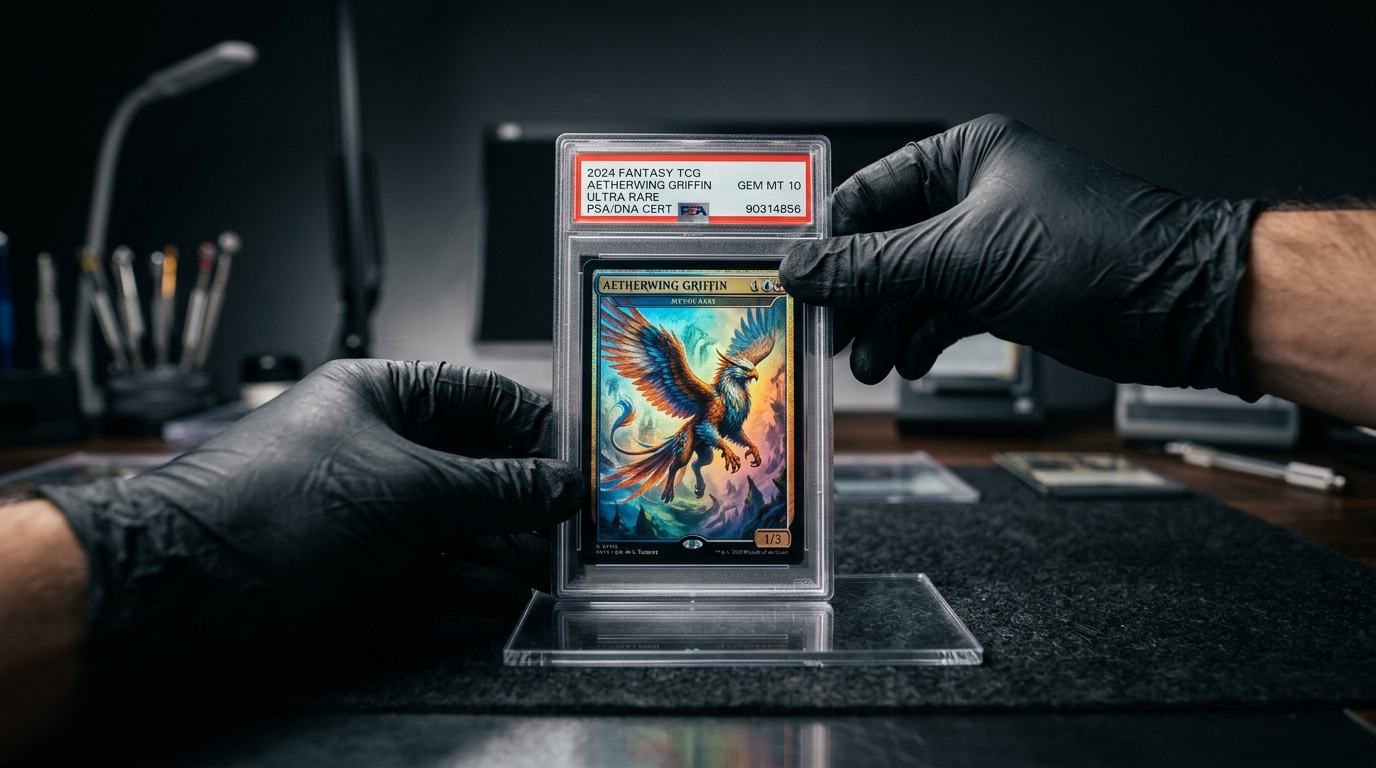
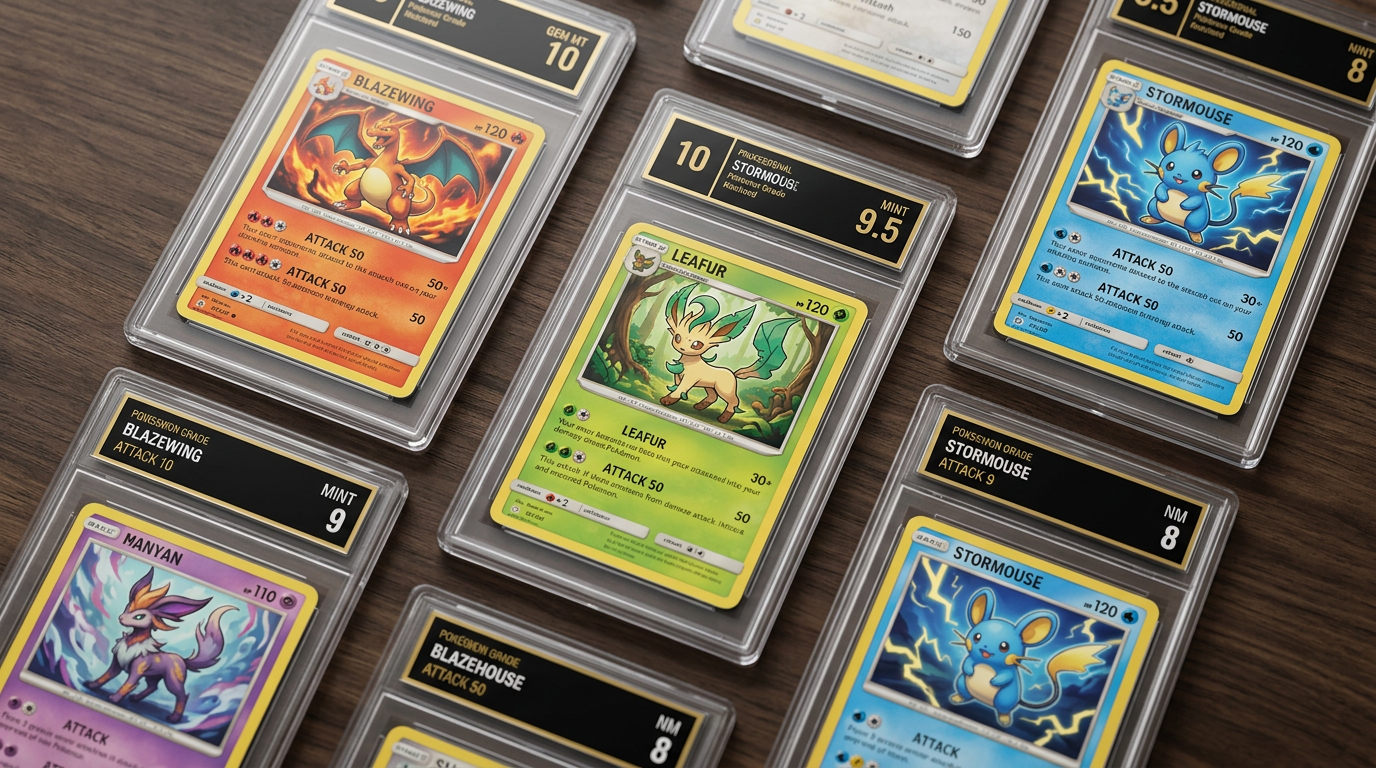
Grading is the process of entrusting your card to a specialized organization that will examine it from every angle: centering, surface, corners, edges. Each criterion is rated, and the card receives a overall score of 1 to 10. It is then sealed in a rigid transparent case — the infamous slab — with a label indicating the score, the card name, the set, and a unique identification number.
It's a bit like having a jewelry or luxury watch appraised: once certified, the item no longer needs to prove anything. Its condition is guaranteed, documented, and recognized worldwide.
The most historically well-known organizations — PSA, BGS, CGC — are all based in the United States. Sending your cards there means accepting delays of several months, international shipping costs, and a significant logistical risk. This is where European and French players come into play.
5 Solid Reasons to Get Your Cards Graded
1. Unmatched Physical Protection
We’ve all been there: a card left on a desk, a glass of water spills, an album falls... Unprotected cards deteriorate quickly, even with the best sleeves. The grading slab is a rigid, UV-resistant, moisture-proof, shock-proof capsule. Your card is frozen in time. No scratches, no accidental creases, no yellowing. For a card worth €50 or €5,000, peace of mind is priceless.
2. A Market Value That Can Explode
Here's the reality of the market:
- A Base Charizard in good condition trades for around €200-400. In PSA 9, expect €800-1,200. In PSA 10? We're easily exceeding €5,000.
- A Pikachu Illustrator that is ungraded is already worth a fortune, but graded PSA 10 examples are reaching auction sale records.
- Even modern cards are seeing their values soar: an alt art Rayquaza VMAX in PSA 10 is worth 2 to 4 times more than the raw version.
Grading doesn’t create value — it certifies and amplifies it. A buyer knows exactly what they are purchasing. No more doubts, no more negotiations about condition. The price follows.
3. A Shield Against Counterfeiting
The Pokémon card market is unfortunately infested with fakes. Counterfeits are becoming increasingly sophisticated, and even a trained eye can get caught out in an online sale. Grading acts as a certificate of authenticity: each card is verified by experts before being encapsulated. If the card is a fake, it is rejected. End of story.
4. A Universal Language for the Market
When you sell a card labeled "NM" (Near Mint) on a forum or marketplace, not everyone shares the same definition of "Near Mint". A 9 from one seller might be a 7 from another. Grading eliminates this artistic blur: a 9 is a 9. It doesn’t matter if you’re selling in Lyon, Tokyo, or New York. This standardization facilitates transactions and builds trust between buyers and sellers.
5. Liquidity in the Secondary Market
Graded cards sell faster than raw cards. On eBay, Cardmarket, or specialized groups, a slab immediately attracts attention. Serious collectors filter by grade. Investors only look at certified cards. If you want to sell quickly and at the best price, grading is a liquidity accelerator.
SFG Grading: The French Grading Revolution
Now that we've laid the groundwork, let’s talk about what really interests us: SFG Grading (Société Française de Gradation). And honestly, it’s a breath of fresh air in a market long dominated by American giants.
The Local Touch That Changes Everything
SFG Grading is primarily a French player, based in France. For collectors from the Lyon area and the Rhône-Alpes region, this is a significant advantage: there’s no need to send your cards across the Atlantic. A tracked Colissimo shipment, and within a few days, your cards are in the hands of French-speaking experts who understand the European market.
And for those who prefer direct contact, the option to drop off your cards in person or use regional relay points makes everything even easier. No more anxiety about your cards crossing the ocean in a box.
Pricing That Makes You Think
Let’s be honest: grading at PSA is pricey. Between service fees (which start around $20-25 for the most basic tier), international shipping costs, potential customs fees, and the endless wait... the bill adds up quickly.
SFG Grading offers competitive rates, designed for the French market. Prices remain accessible, allowing you to grade modern cards without it becoming an investment in itself. For collectors wanting to grade multiple cards at once, bulk formulas make it even more attractive.
Turnaround Times That Don’t Just Dream… They Get Things Done
This might be the argument that makes the difference. At PSA, during standard periods, expect easily 2 to 6 months. At some premium services, we’re talking a minimum of 30 working days — and the price skyrockets.
SFG Grading focuses on short turnaround times: you get your graded cards back in a reasonable time, without feeling like you’ve sent your treasures into a black hole. For resellers and collectors who frequently handle many cards, this time gain translates directly into profitability.
The Partner Offer: Real Margins for Professionals
This is where it gets really interesting for resellers and shops. SFG Grading offers partner packages specifically designed for market professionals: scaled pricing, negotiated volumes, dedicated support.
In concrete terms, this means real margins on grading. You buy raw cards at a good price, have them graded at SFG, and the added value on resale is significant. It’s a viable business model — not a luxury hobby. For shops and online resellers, it’s a concrete growth lever.
The Referral Program: Earn on Every Sale
The icing on the cake: SFG Grading has set up a commission-based referral program. The principle is simple and transparent: you refer a new client, and you earn a commission on the sales made by your referral.
This isn’t dubious network marketing — it’s a classic referral program like those seen in the best SaaS. For content creators, Pokémon influencers, local shops, or simply passionate individuals with an active network, it’s a real supplemental income. The more you refer, the more you earn. And your referrals also benefit from quality service, so everyone wins.
When Should You Grade Your Cards?
Grading isn’t relevant for all cards. Here are our criteria for deciding:
- The raw card value exceeds €30-50: below this, the grading cost cuts too much into the margin. Above that, the multiplier justifies the service.
- The condition is excellent: if your card has a visible defect (crease, pronounced whitening, major miscentering), the grade will be low and the investment less profitable. Aim for NM+ condition or better.
- The card has resale potential: highly sought-after alt arts, vintage first edition cards, rare pulls from recent sets — anything in demand deserves to be graded.
- You plan to keep it for a long time: even without an immediate resale plan, the slab provides long-lasting protection. If the card has significant sentimental value, grading preserves it for decades to come.
Our Verdict
Grading is no longer an option reserved for hardcore American collectors. With players like SFG Grading, it has become accessible, quick, and economically relevant — especially if you’re in France.
Whether you’re a passionate collector wanting to protect your finest pieces, an investor looking to maximize margins, or a reseller wanting to professionalize your activity, grading is an essential tool in 2026.
And honestly, when we see the quality of service, the proximity, the pricing, and the partner programs offered by SFG Grading, we wonder why we would still send our cards to the other side of the world. The answer is in the slab — and it’s French.